Whether your course moves on a fixed schedule or lets you set your own pace, time is your most limited resource. This guide gives you a research-backed framework for managing it well – whatever your course format.
The format of your course changes the shape of your time pressure – but not whether time pressure exists. Both paced and self-paced learners struggle. The strategies that help are different. Knowing which you need is the first step.
Part 1 · Know Your Environment
Paced and self-paced: two very different time challenges
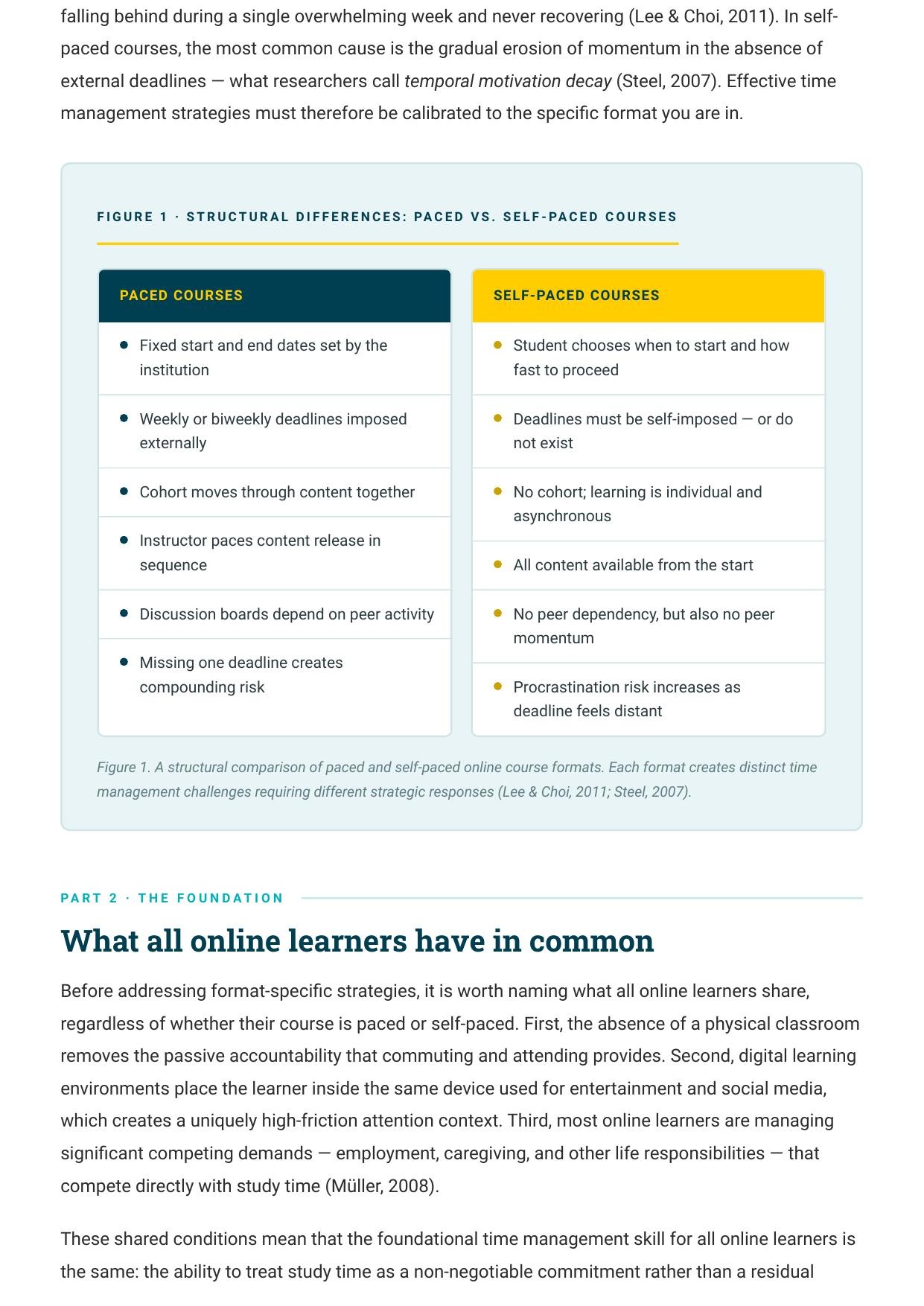
Online learning encompasses two structurally distinct course formats, and the time management challenges they create are not the same. A paced course runs on a fixed schedule: weekly deadlines, a defined start and end date, and an instructor who moves the class through content in sequence. A self-paced course removes that external scaffolding – you receive the full course at once, choose your own start date, and are responsible for creating both the structure and the momentum that a paced course provides automatically.
Research consistently shows both formats carry high dropout risk, but for different reasons. In paced courses, the most common cause of disengagement is falling behind during a single overwhelming week and never recovering (Lee & Choi, 2011). In self-paced courses, the most common cause is the gradual erosion of momentum – what researchers call temporal motivation decay (Steel, 2007). Effective time management strategies must be calibrated to your specific format.
Part 2 · The Foundation
What all online learners have in common
Before addressing format-specific strategies, it is worth naming what all online learners share. First, the absence of a physical classroom removes the passive accountability that commuting and attending provides. Second, digital learning environments place the learner inside the same device used for entertainment and social media. Third, most online learners are managing significant competing demands – employment, caregiving, and other life responsibilities – that compete directly with study time (Müller, 2008).
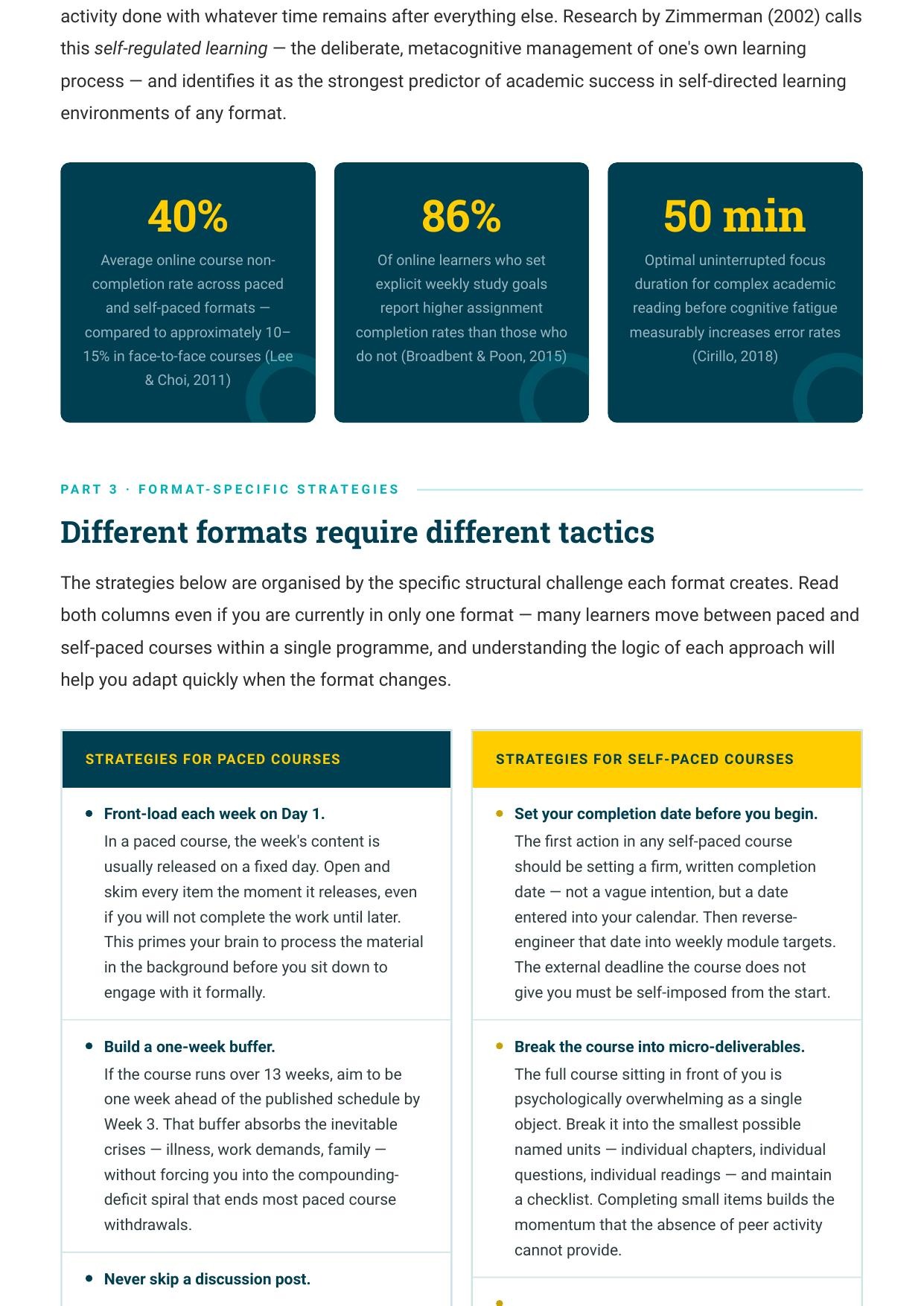
Research by Zimmerman (2002) calls this self-regulated learning – the deliberate, metacognitive management of one’s own learning process – and identifies it as the strongest predictor of academic success in self-directed learning environments of any format.
Part 3 · Format-Specific Strategies
Different formats require different tactics
The strategies below are organised by the specific structural challenge each format creates. Read both columns even if you are currently in only one format – many learners move between paced and self-paced courses within a single programme.
STRATEGIES FOR PACED COURSES
Front-load each week on Day 1. Open and skim every item the moment it releases. This primes your brain to process the material before you engage with it formally.
Build a one-week buffer. Aim to be one week ahead by Week 3. That buffer absorbs illness, work demands, and family crises without forcing you into the compounding-deficit spiral that ends most paced course withdrawals.
Never skip a discussion post. Disappearing from the discussion board is the most visible signal that a student is struggling – and it compounds isolation. Post early, even briefly, to stay visible and connected.
Treat the syllabus as your primary planning document. Map every due date into your calendar in the first week. Students who do this in the first 48 hours complete at significantly higher rates (Lee & Choi, 2011).
STRATEGIES FOR SELF-PACED COURSES
Set your completion date before you begin. Enter a firm completion date into your calendar – not a vague intention. Then reverse-engineer that date into weekly module targets.
Break the course into micro-deliverables. Break it into the smallest possible named units – individual chapters, questions, readings – and maintain a checklist. Completing small items builds the momentum the absence of peer activity cannot provide.
Create artificial social accountability. Tell someone what you intend to complete by a specific date and ask them to check in. Research shows social accountability increases follow-through by 33% (Gollwitzer & Sheeran, 2006).
Protect your start date. Temporal motivation decay typically begins before the course even starts – with repeated delays to the start date. Enrol, open the course, and complete the first module within 24 hours of receiving access. The momentum of having begun is itself protective.
Part 4 · Universal Strategies
Strategies that work regardless of format
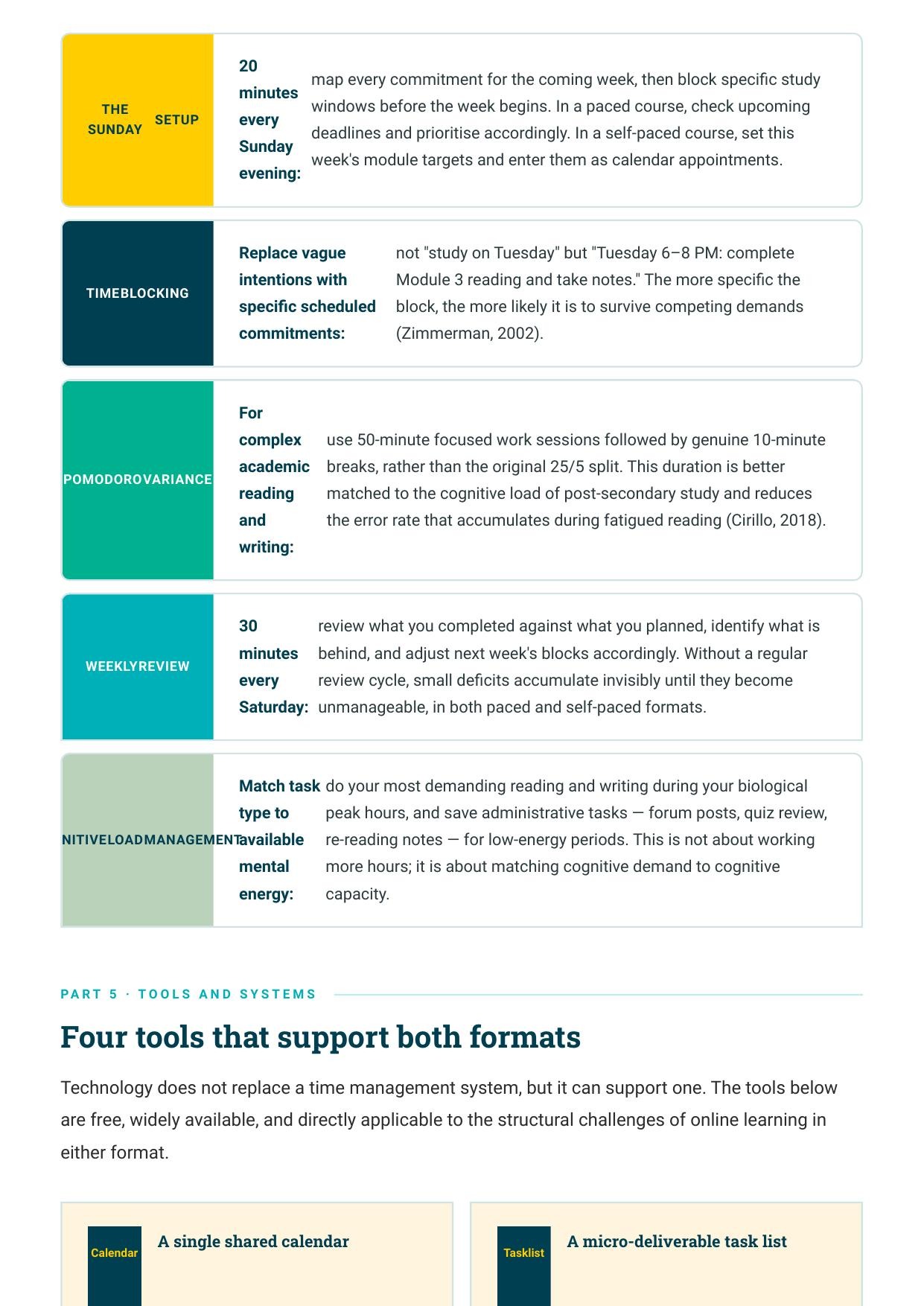
The five strategies below are format-agnostic, drawn from the self-regulated learning research literature and demonstrated effective across both paced and self-paced online learning contexts.
Part 5 · Tools and Systems
Four tools that support both formats
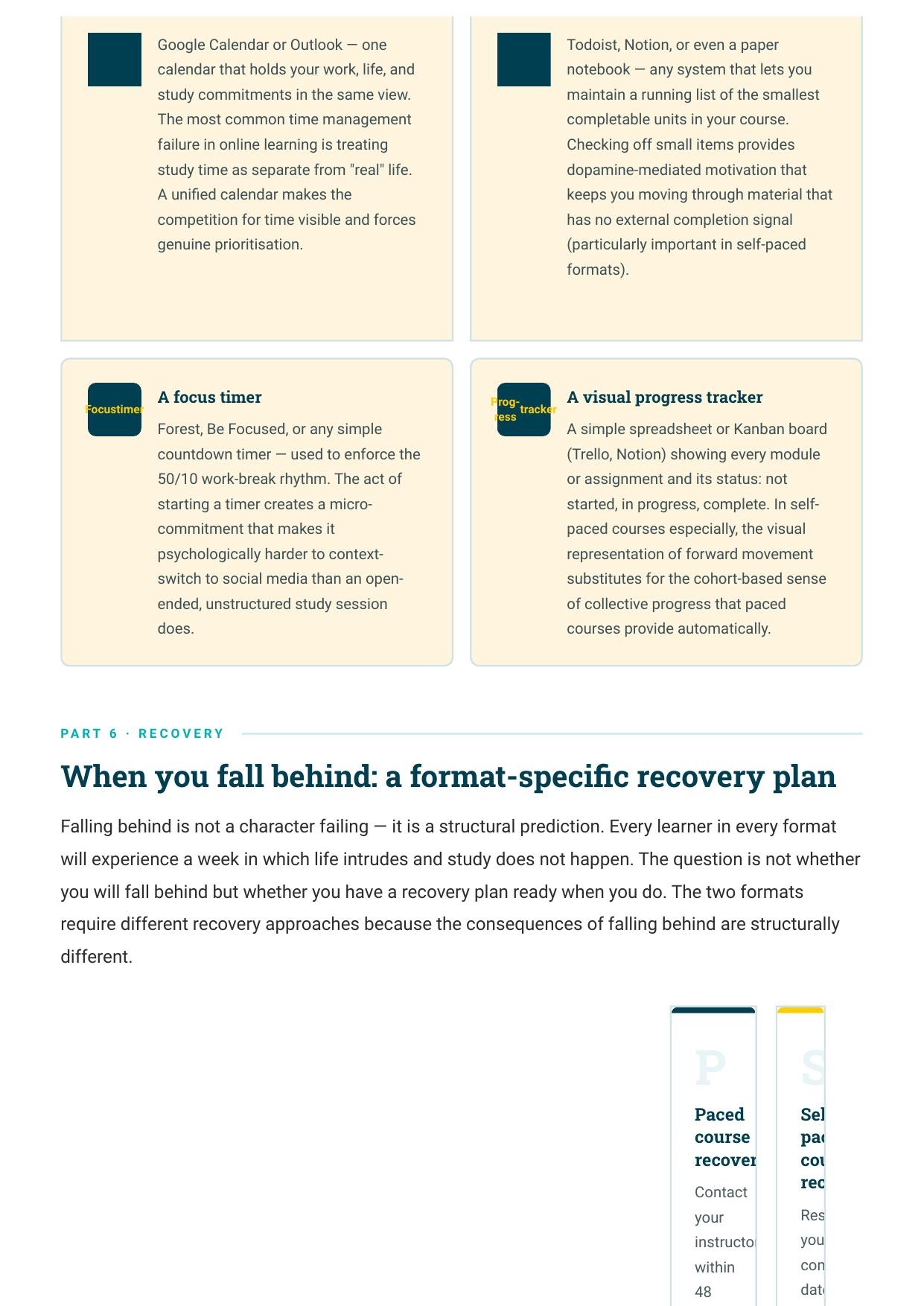
Technology does not replace a time management system, but it can support one. The tools below are free, widely available, and directly applicable to the structural challenges of online learning in either format.
Part 6 · Recovery
When you fall behind: a format-specific recovery plan
Falling behind is not a character failing – it is a structural prediction. Every learner in every format will experience a week in which life intrudes and study does not happen. The question is not whether you will fall behind but whether you have a recovery plan ready when you do.
Paced Course Recovery
Contact your instructor within 48 hours of missing a deadline – before the next one arrives. Most instructors can accommodate a single gap if notified early. Do not attempt to complete two weeks of work in one week without adjusting your life commitments. Identify the one highest-weighted item you missed and submit something, even if incomplete.
Self-Paced Course Recovery
Recalculate your completion date by the exact number of weeks you lost and update your weekly targets accordingly. Reset the Sunday Setup ritual immediately. Do not attempt to double weekly workload – this creates unsustainable pressure that typically leads to a second, larger gap. A realistic reset beats an ambitious plan that fails.
Your course is already open. The best time management decision you can make right now is to schedule next week before this one ends.
References
Broadbent, J., & Poon, W. L. (2015). Self-regulated learning strategies and academic achievement in online higher education learning environments: A systematic review. The Internet and Higher Education, 27, 1–13. https://doi.org/10.1016/j.iheduc.2015.04.007
Cirillo, F. (2018). The Pomodoro technique: The life-changing time-management system. Currency.
Gollwitzer, P. M., & Sheeran, P. (2006). Implementation intentions and goal achievement: A meta-analysis of effects and processes. Advances in Experimental Social Psychology, 38, 69–119. https://doi.org/10.1016/S0065-2601(06)38002-1
Lee, Y., & Choi, J. (2011). A review of online course dropout research: Implications for practice and future research. Educational Technology Research and Development, 59(5), 593–618. https://doi.org/10.1007/s11423-010-9177-y
Steel, P. (2007). The nature of procrastination: A meta-analytic and theoretical review of quintessential self-regulatory failure. Psychological Bulletin, 133(1), 65–94. https://doi.org/10.1037/0033-2909.133.1.65
Zimmerman, B. J. (2002). Becoming a self-regulated learner: An overview. Theory Into Practice, 41(2), 64–70. https://doi.org/10.1207/s15430421tip4102_2
Published under Creative Commons Attribution 4.0 International (CC BY 4.0). Tucker, A. (2026). Time management for every learner: Paced and self-paced strategies that work. Open Learning Student Resource Series.